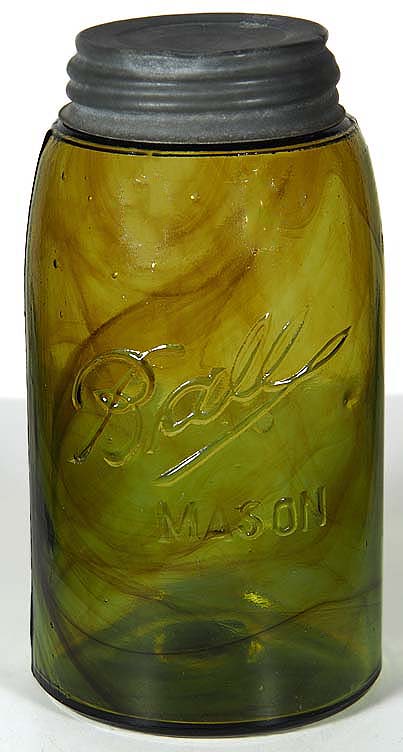
This is possibly the most important section of this book to read so you have a better understanding of color and why so many collectors have differences of opinion when describing and determining colors.
Over the last 40 years I have lost count of the number of discussions and even down right disagreements that turned into an argument over the color name given to a jar. After carefully studying how the human eye interprets the spectrum of color, I have come to understand that in many cases both people who were in disagreement were actually both correct.
How can this be? Technically, it cannot be. However, each human eye processes color differently. So the two who are in disagreement with each other, about a specific color, actually see the jar color differently.
This becomes more obvious as I travel to appraise, view and record jars from other long-term collections. I have noticed that many collectors gravitate towards a certain color range. Examples include a collector of 50+ years, on the West Coast, who predominately has jars in the Green Spectrum and another in the Heartland who has every shade of Amber including examples with very slight differences that virtually no one seems to see as easily as him. These are excellent examples, in my opinion, of how each human experiences the visual perception of color differently.
Acknowledged Jar Color Terms Used:
Dead Clear, Near Clear, (SCA)Sun Colored Amethyst, Aqua, Apple Green, Lime Green, 7Up Green, Emerald Green, Yellow Green, Citron, Straw Yellow, Olive Yellow, Yellow Olive, Amber Olive, Amber Yellow, Yellow Amber(Honey), Medium to Dark Amber, Dark Amber, Olive Amber, Light Olive, Medium Olive, Dark Olive, Sky Blue, Ball Blue, Light Cornflower, Medium Cornflower, Dark Cornflower, Sapphire, Light Cobalt, Medium Cobalt, Dark Cobalt, Teal Blue, Teal Green(Blue Green), Peacock Blue, Prussian Blue, Black Amethyst, Black Amber and Black Olive. That makes 40+ distinctive colors that can be collected with numerous variations in between and several more that are difficult to name.
Gradients of Color Saturation:
Very Light, Light, Medium, Dark, Very Dark, Black/Opaque.
Jars with high enough levels of manganese dioxide will often turn a light to medium shade of (purple)Amethyst if exposed to sunlight over a period of time. Natural SCA jars are collectible however, beware that there are a number of people who turn clear/near clear jars with modern technology to quicken the SCA process. Most of these are easy to spot as they are TOO Dark Purple(SCA) and not natural looking. A trained eye from any long time jar collector will easily know the difference. Some of these radiated jars come out in a off brown color and are not natural.